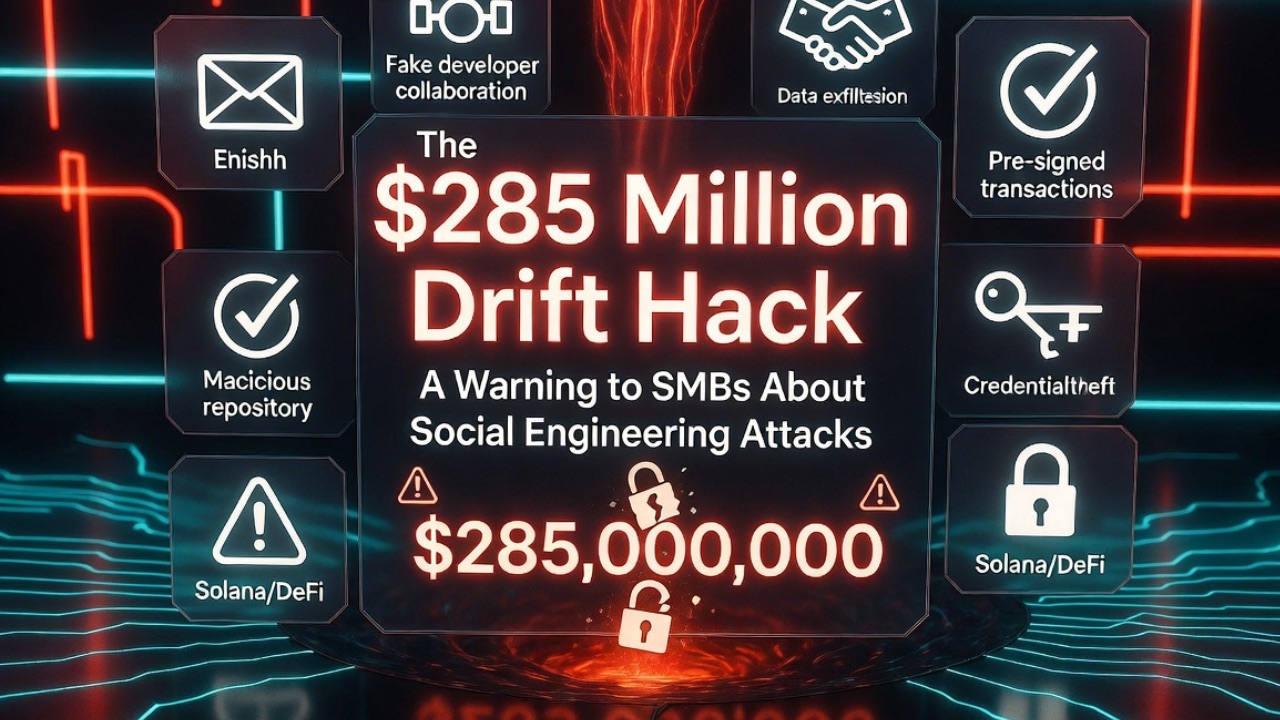
The $285 Million Drift Hack: A Warning to SMBs About Social Engineering Attacks
Published April 6, 2026
The $285M Wake-Up Call: Why Your Company Is Already a Target
Most company leaders still believe cyber attacks happen to “someone else.”
A large enterprise. A bank. A crypto giant.
But that assumption is exactly what attackers are counting on.
The recent $285 million breach at the decentralized exchange Drift wasn’t a smash-and-grab attack. It was something far more dangerous: a six-month-long social engineering operation, allegedly orchestrated by the DPRK.
No zero-days. No Hollywood hacking scenes.
Just patience... and people.
Attackers carefully targeted employees, built trust, and used highly convincing phishing emails to gain access to sensitive systems. And once inside, the damage was catastrophic.
Now here’s the uncomfortable truth:
The same tactics used in a $285M attack work even better on organisations not as large as Drift.
Why?
Because smaller organizations typically lack:
- Continuous visibility of their external exposure
- Structured employee awareness programs
- Monitoring of suppliers and third-party risk
- Early warning systems for compromised credentials or infrastructure
That’s exactly where modern cyber risk begins.
You’re Not Being Hacked — You’re Being Profiled.
Today’s attackers don’t start with your firewall.
They start with your exposed attack surface:
- Misconfigured email security (SPF, DKIM, DMARC)
- Missing security headers on your website
- Expiring SSL certificates
- Open ports and forgotten subdomains
- Employees with leaked credentials
In fact, in a recent SME scan (see your own ExposureIndex reports), we often find:
- Weak email authentication policies (e.g. soft fail SPF, missing DKIM)
- No DMARC enforcement
- Zero security headers implemented
- Single points of failure in email infrastructure
- Expiring certificates within weeks
None of these are “critical vulnerabilities” on their own.
But together?
They create the perfect entry point for a social engineering attack—just like the one that hit Drift.
The Real Risk: Social Engineering at Scale
Phishing is no longer obvious.
Attackers now:
- Mimic suppliers, partners, and internal executives
- Time attacks based on business cycles
- Use real leaked credentials to increase credibility
- Combine technical misconfigurations with human manipulation
This is why traditional security tools often miss the bigger picture.
They look inward.
Attackers look outward.
What Actually Works for SMEs
If you’re leading an SME, cybersecurity isn’t about buying more tools.
It’s about reducing real-world exposure.
Here’s where to start:
-
Make Employees Your First Line of Defense.
Not your weakest link.
Train them continuously to:
- Recognize sophisticated phishing attempts
- Question urgency and unusual requests
- Verify sensitive actions through secondary channels
-
Lock Down Identity & Access.
Passwords alone are obsolete.
- Enforce 2FA/MFS across all critical systems (we'll cover this topic in depth in an upcoming blog post)
- Monitor for leaked credentials in real time
- Act immediately when exposure is detected
-
Fix What Attackers Actually See.
Most companies don’t know what they’re exposing.
- Harden email authentication (SPF, DKIM, DMARC)
- Implement critical security headers
- Monitor SSL, DNS, and open services
- Eliminate shadow IT and forgotten assets
-
Understand Your Supply Chain Risk.
You are only as secure as your weakest vendor.
- Identify which providers you rely on
- Monitor them for breaches and known vulnerabilities
- Act before their risk becomes your incident
Where ExposureIndex Changes the Game
This is exactly why we built ExposureIndex.io.
Not another dashboard full of noise.
But a platform that shows you:
“Your company — from a hacker’s perspective.”
With ExposureIndex, you can:
- Continuously monitor your external attack surface
- Detect misconfigurations before attackers do
- Identify exposed credentials and identity risks
- Track your suppliers’ security posture automatically
- Translate technical findings into business impact
In other words:
You stop reacting to threats...
... and start eliminating the conditions that make attacks possible.
Final Thought
The Drift attack wasn’t exceptional because of its scale.
It was exceptional because of its simplicity.
No company is too small to be targeted.
But companies that understand their exposure? - They’re exponentially harder to attack.
← Back to blog
Is your attack surface exposed?
ExposureIndex continuously monitors your external attack surface — domains, email security, open ports, and more. Start your free pilot today.
Start monitoring